
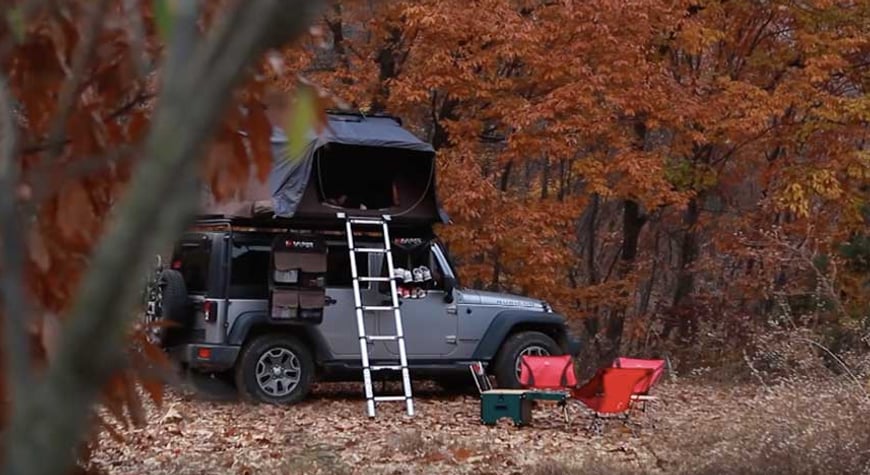
How a Bad Family Trip Changed Rooftop Camping
The Camping Problem Nobody Had Solved
Rooftop tents have existed in some form since the mid-20th century, popular with overlanders in Africa and Europe long before they caught on in North America. But for decades, the core problem remained: they were heavy, slow to deploy, and required two people minimum to set up properly. Ground tents had evolved dramatically — lighter, smarter, more weather-resistant — while rooftop designs largely stayed stuck in the same basic format. That gap between what rooftop camping could be and what it actually was is exactly what gave one designer the motivation to start over from scratch and build something the market had never seen before.
A Road Trip That Did Not Go as Planned
The iKamper Skycamp traces its origins to a specific, frustrating experience. Designer Soon Park set out on a camping road trip with his wife and two daughters, expecting the kind of adventure that outdoor enthusiasts live for. What he got instead was a reminder of how much friction still exists in traditional camping gear. Setting up camp took far longer than it should have. The process required more effort and coordination than one person could reasonably manage alone. Park, a designer by training, looked at the problem the way designers do — not as an inconvenience to tolerate, but as a puzzle worth solving. That trip planted the seed for what would eventually become one of the most successful outdoor gear campaigns in Kickstarter history.
What Makes a Rooftop Tent Different From Ground Camping
Before getting into the Skycamp specifically, it helps to understand why rooftop tents occupy a distinct category in the camping world. Sleeping on the roof of a vehicle gets you off the ground entirely, which means no rocks, roots, moisture seeping through the floor, or concerns about insects and small animals at ground level. Setup happens on a flat, stable platform regardless of the terrain below. You can park on a slope and still sleep level if the tent is designed correctly. For overlanders — people who drive remote routes and camp wherever the day ends — the ability to pull over anywhere and sleep securely without scouting a flat patch of earth is a genuine practical advantage, not just a novelty.
The Engineering Behind a One-Minute Setup
The signature claim of the Skycamp is its setup time: less than one minute, manageable by a single person. That is a meaningful engineering achievement, not marketing language. Traditional rooftop tents use a hinge-and-ladder system that requires the user to unlatch the cover, prop the shell open, unfold the mattress, and extend a ladder — a sequence that can take five to ten minutes even with practice. The Skycamp uses a hardshell design with an automated opening mechanism. The hard case protects the tent from road debris and weather while traveling, and the entire unit unfolds in a single continuous motion. The mattress stays inside and requires no repositioning. For a tired driver arriving at a campsite after dark, that difference in setup time is not trivial.