How Smart Travelers Are Flying United Without Paying a Single Baggage Fee

TRAVELHow Smart Travelers Are Flying United Without Paying a Single Baggage Fee4 min read
How Smart Travelers Are Flying United Without Paying a Single Baggage Fee

The Carry-On Rules Nobody Reads Until Too Late

Every United passenger gets a personal item — no debate. Backpack, purse, laptop bag, approved pet carrier. Keep it under 9 by 17 by 10 inches and shove it under the seat in front of you. That part is simple.

The full-size carry-on is where things get slippery. United allows bags up to 22 by 14 by 9 inches in the overhead bin, free of charge — for most passengers. Most.

Book a basic economy ticket and that overhead bin might as well be behind velvet rope. Basic economy passengers get the personal item only. Show up at the gate with a roller bag and United charges you the standard checked bag fee plus a $25 gate penalty on top. That’s an expensive lesson to learn at 6 a.m. in terminal C. There are exceptions — certain elite status levels, specific routes — but if you’re buying the cheapest fare United offers, pack accordingly.
United Airlines Boeing 737 taxiing on a runway with suburban backdrop on a sunny day.

What United Actually Charges to Check a Bag

For flights within North America, Central America and the Caribbean, the first checked bag runs $40. The second costs $50. Prepay at least 24 hours before departure and United shaves $5 off each of those first two bags — except to Canada, where that discount quietly disappears.

Elite status reshapes those numbers fast. Premier Silver members fly their first bag free. Premier Gold and above get the first two bags free. Premier 1K members — United’s top tier — add a free third bag on domestic routes. Star Alliance Gold members earn at least one free checked bag on all United-operated flights worldwide, regardless of which airline they booked through.
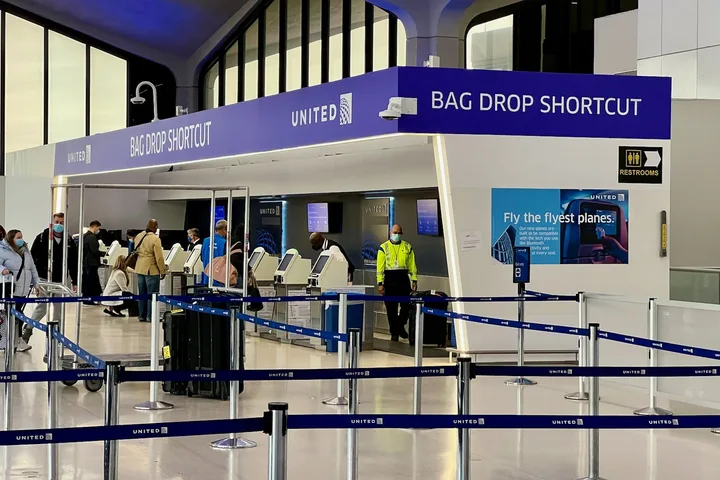
United Airlines bag drop shortcut counter with passengers and staff in an airport terminal.

Once the itinerary crosses into Europe, Asia or beyond, the math shifts again. International routes often carry more generous allowances baked into the fare, but specifics vary so widely by region and cabin that United built a dedicated baggage fee calculator on its website. Log in with your MileagePlus account and you can search your exact itinerary — no guessing, no surprises at the counter.
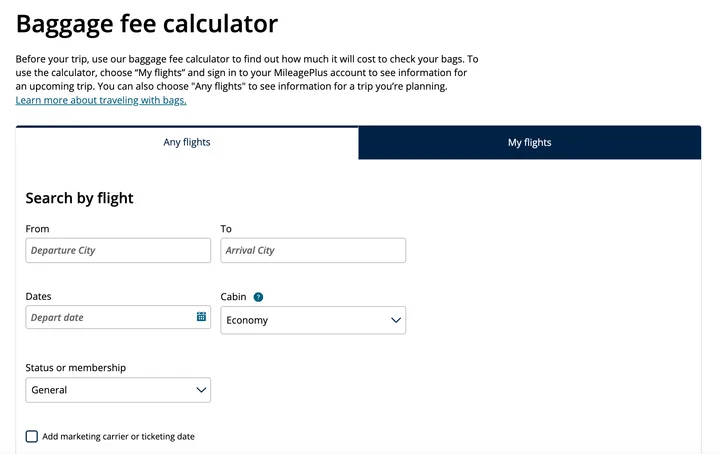
Screenshot of United Airlines baggage fee calculator web tool with flight search fields.

When the Fees Get Genuinely Brutal

Clear 50 pounds on a domestic economy ticket and United starts stacking overweight fees on top of the base checked bag charge. Elite members and premium cabin passengers get a 70-pound allowance before the penalties kick in. Exceed both the weight limit and the size limit on the same bag and United charges both fees. The bills add up fast.

A third checked bag on a domestic U.S. flight starts at $150. Buried in the fine print: United will only accept extra bags when space is available and certain routes may carry additional restrictions. Don’t bank on that third bag making the plane.

Sports equipment is its own category. Skis, snowboards, parachutes and hang-gliding gear all travel as checked bags under standard rates as long as they meet United’s requirements. Scuba tanks carry a separate fee. Kayaks and canoes? United won’t take them at all.

Credit Cards That Make Bags Disappear

The United Explorer Card and United Business Card give the primary cardholder and one traveling companion a free first checked bag on every United-operated flight. The catch: you must book the ticket using that card. Forget to swipe the right one at checkout and the benefit evaporates — United doesn’t apply it retroactively.

Step up to the United Quest Card, United Club Card or United Club Business Card and the benefit doubles. Those cardholders plus one companion check both the first and second bags free on United-operated flights. Same booking requirement applies. The savings on a round trip for two passengers covering two bags each can easily clear $300 annually — enough to justify the card’s annual fee on its own.