
The Empty Seat Beside Me Told Me Everything About My Marriage
The auditorium filled fast. I’d grabbed front-row seats early, draped my coat across the one beside me, sent him a text: Row 1, center. Your spot’s saved. Our daughter had a solo—her first real moment in the spotlight—and I wanted us both there close enough for her to find our faces when she needed them. He was running late. He was often running late. I told myself it was fine.
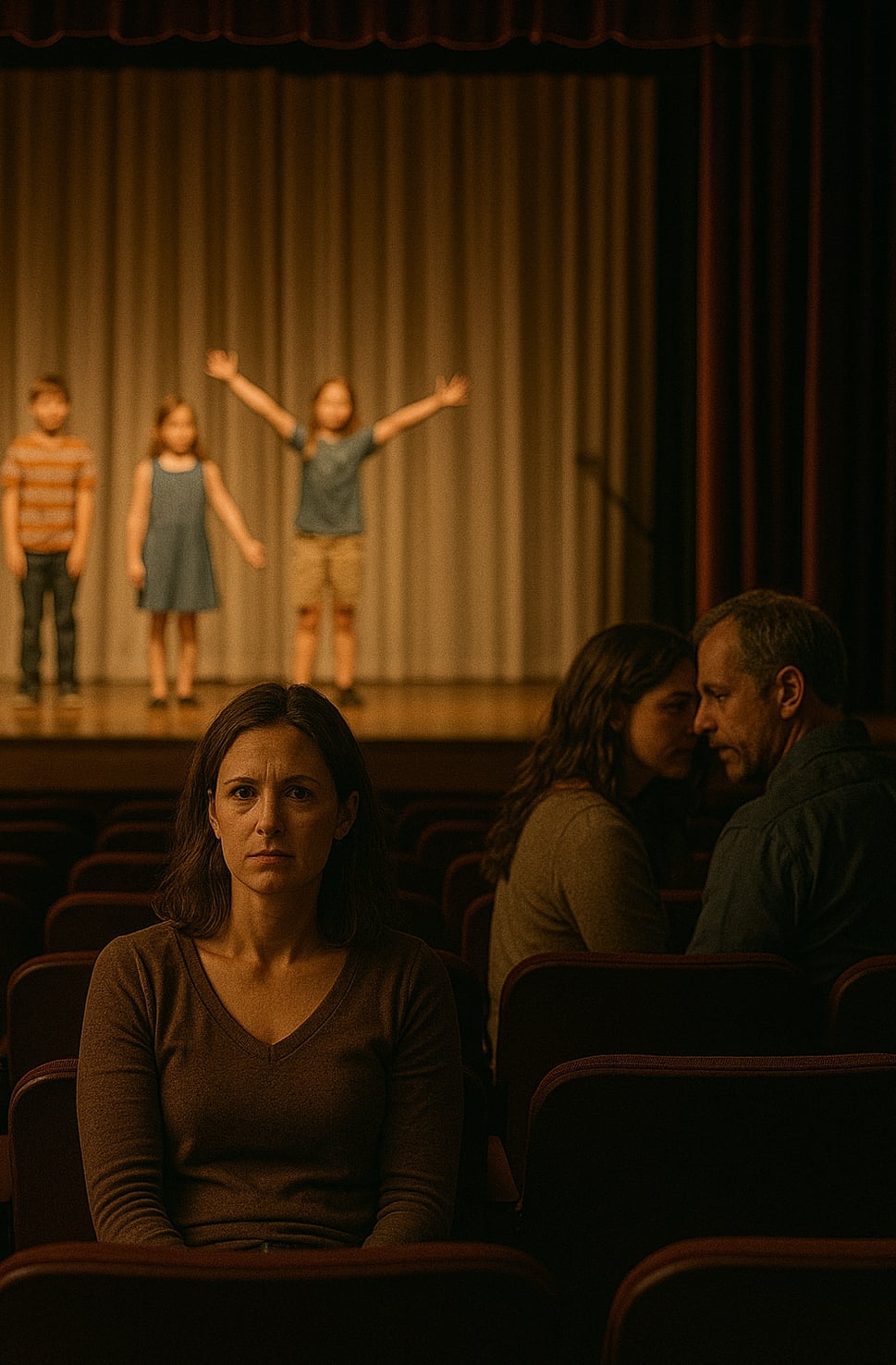
When the house lights dropped and the noise collapsed to a hush, the seat next to me was still empty. I turned. Two rows back, I found him—not lost, not searching, not even looking my way. Settled. Comfortable. He was leaning toward a woman I recognized from the school pickup line, and she was laughing softly at something he’d said close to her ear. Her hand rested briefly on his arm. He didn’t pull back. He leaned in closer. Around me, parents raised phones to catch the opening number. I sat there with my coat folded in my lap, watching my husband choose a seat fifty feet behind me over the one I’d held for an hour.
Our daughter came out in the second number—chin up, eyes bright, her voice carrying clean and clear over the piano. I arranged my face into something a normal mother would wear at a school play. Kids scan the audience when they perform; they look for the faces that say you’re seen, you matter. I was in row one, alone. Her father was in row three, whispering. At intermission I turned to confront him and found two empty chairs. They’d stepped out together. I stood in the aisle gripping my program until the paper went soft between my fingers, edges tearing from the pressure. When the lights dimmed again they slipped back in near the exit doors, just in time for act two. He caught my eye across two hundred heads. Guilt hit his face like a flinch—brief, involuntary, gone—and then he stayed where he was.
“It was crowded,” he said on the drive home. “There weren’t enough seats.”
I told him I’d saved him one. He knew exactly where I was. The arithmetic is simple: our daughter was eight years old and singing her lungs out on a stage, and for ninety minutes he chose to sit with someone else. After the curtain call she ran backstage still glowing, breathless, and asked did you see me, did I do good—and the question landed somewhere tender. Yes, baby. We saw you. I said she was perfect. I hugged her until she wriggled free and ran back to her cast.
The drive home was seventeen minutes of silence so solid you could knock on it. When I finally asked, his answer was logistical, almost bored—crowded, not enough seats—as if what had happened were a question of geometry rather than a choice. Every marriage runs on small choices that compound without fanfare. Which side of the bed. Who locks up at night. Where you sit at your daughter’s school play. Most of them don’t register. A few of them do. The empty seat beside me had a specific weight to it, something I carried home and couldn’t set down. That night I lay awake turning it over—the coat draped across the chair I’d saved, her hand on his arm, the moment he caught my eye and stayed put anyway. Betrayal doesn’t always require a locked door and a secret phone. Sometimes it plays out at full volume, under stage lights, in front of your child and two hundred strangers. Sometimes the choice is visible to everyone and still, somehow, only truly seen by you.