
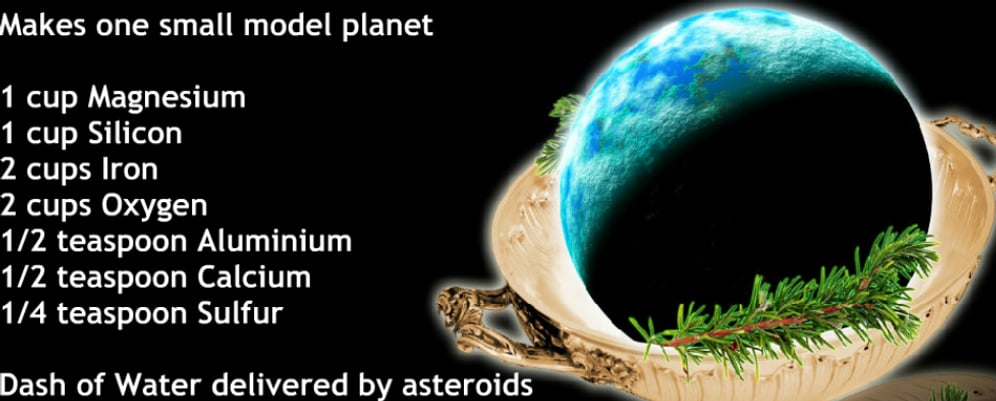
The Real Recipe Behind Earth-Like Planets
Scientists Now Know What Rocky Planets Are Made Of
For decades, astronomers have pointed telescopes at distant stars and spotted small worlds orbiting them. What they could not do was figure out what those worlds were actually built from. That changed when a research team presented findings at a meeting of the American Astronomical Society, revealing that Earth-like planets across the galaxy share a strikingly familiar chemical makeup. The short version: the universe builds rocky planets from the same basic kit it used to build Earth. The discovery shifts how scientists think about planetary formation and, more importantly, where they should look when searching for worlds that could support life.
What ‘Earth-Like’ Actually Means to Astronomers
The term gets thrown around loosely, but scientists use it precisely. An Earth-like planet, or exoplanet, is a small, rocky world that orbits a star — not a gas giant like Jupiter, not an icy body drifting in the outer dark. It has mass, density, and a solid surface. Since the first confirmed exoplanet discovery in the 1990s, astronomers have catalogued nearly 2,000 of these objects. That number alone tells a story: small, rocky planets are not rare accidents. They are a standard product of how stars and their surrounding material organize themselves over millions of years. The question was never really whether they exist — it was what they are made of and whether any of them could resemble home.
The Instrument That Made Precise Measurements Possible
Detecting an exoplanet is one thing. Measuring it accurately enough to determine its internal composition is far harder. The team used the HARPS-North instrument, mounted on the 3.6-metre Telescopio Nazionale Galileo in the Canary Islands. HARPS-North is a high-precision spectrograph designed to detect the subtle wobble a planet induces in its host star as it orbits. By measuring that wobble with exceptional accuracy, scientists can calculate the planet’s mass. Paired with size data from transit observations — where a planet passes in front of its star and dims the light slightly — mass and volume together give density. And density is the key that unlocks composition. Iron and rock are dense. Water and gas are not. The math is straightforward once you have reliable measurements to work with.
Why Kepler-93b Became a Key Test Case
The team focused early attention on Kepler-93b, a planet 1.5 times the diameter of Earth that completes one orbit around its star every 4.7 days. That tight, fast orbit made it an ideal candidate: frequent transits provided abundant light-curve data, and the planet’s gravitational pull on its star was measurable with HARPS-North. What the team found confirmed that Kepler-93b is rocky — not a water world, not a gas planet with a thin rocky shell, but a dense, solid body with a composition consistent with silicate rock and iron. In other words, it matched Earth. That single data point was suggestive, but science does not rest on one example. The researchers needed a larger sample to draw meaningful conclusions.