
How a Religious Massacre Shaped the American Map
Before the First Shot Was Fired
Most Americans trace the country’s colonial history to English settlements at Jamestown or Plymouth Rock. But decades before either of those existed, a violent clash between European powers was already playing out on the coast of present-day Florida. In September 1565, Spanish forces attacked a French Protestant colony, killing more than 130 people in what historians recognize as the first recorded battle between European soldiers on North American soil. The episode was rooted not in territorial ambition alone, but in the same religious wars tearing Europe apart — and its outcome quietly redirected the course of North American colonization for generations.
Why French Protestants Sailed to Florida
The story begins in France during the early 1560s, when the country was fracturing along religious lines. French Protestants, known as Huguenots, faced escalating persecution from the Catholic majority. War and violence were increasingly common, and for many Huguenot leaders, the New World offered something Europe could not: distance from the conflict. With the encouragement of prominent Huguenot commanders, a group of settlers organized an expedition to the Americas. They were not fortune hunters or military expansionists in the traditional sense. They were refugees looking for a place to practice their faith without fear of reprisal — a motive that would prove fatally misaligned with what Spain had planned for the region.
Fort Caroline and the Promise of the New World
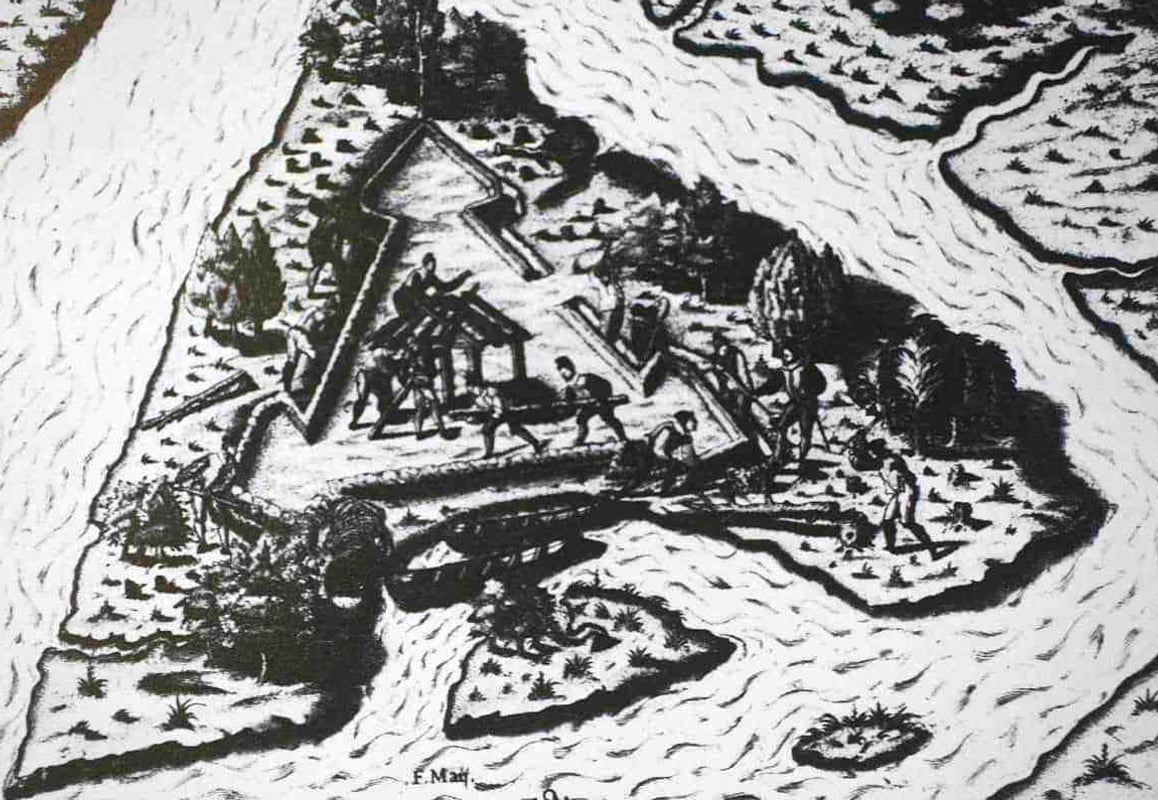
The French Huguenots landed on the coast of what is now northeastern Florida and established a settlement they called Fort Caroline, located near present-day Jacksonville. The site had already been explored by French expeditions, which gave the colonists some confidence in their claim to the land. At Fort Caroline, they built structures, cultivated relationships with local Native Americans, and began the slow work of establishing a functioning colony. Crucially, they could worship as Protestants without interference. For a community that had known nothing but persecution back home, this represented a genuine achievement. But their settlement sat inside territory Spain had formally claimed years earlier — and Spanish officials were paying close attention.
Spain’s Claim on the Continent
Spain’s position on North America was unambiguous, at least from Spain’s perspective. Through a series of papal decrees and royal charters, the Spanish crown had asserted dominion over vast stretches of the Americas, including Florida. Spain had explored the Florida peninsula before the French arrived, and the region was considered part of the Spanish empire by default. When reports reached Madrid that French Protestants had built a permanent settlement on Spanish-claimed soil, the reaction was swift and furious. King Philip II of Spain, the most powerful monarch in Europe at the time, personally ordered that the Huguenots be expelled and that Spain establish its own lasting presence in Florida. This was not a bureaucratic dispute — it was a royal command backed by military force.