HISTORYWhat Ancient Korean DNA Reveals About Society7 min read
Evidence of a Sacrificial Caste
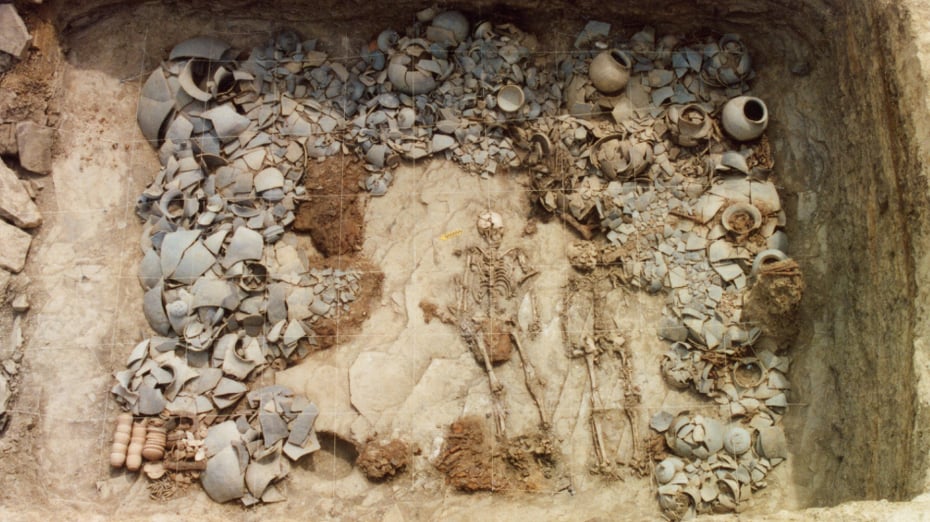
The multi-generational pattern is what led researchers to suggest the existence of a sacrificial caste: a hereditary group of families whose social role, across consecutive generations, was to be killed and buried with the ruling class. The study states directly that “genetic relatedness among sacrificial individuals over generations may suggest the presence of families that served as sacrificial individuals for the grave owner class for consecutive generations.” If accurate, this would represent a form of institutionalized, inherited servitude more rigid than ordinary slavery — one in which the obligation to die for one’s lord was passed from parent to child as a fixed social condition, embedded in the structure of Silla society itself.
Inbreeding Among Both Elites and Retainers
The researchers also found evidence of consanguineous marriage — unions between related individuals — practiced by both the Silla elite and the retainer class. Five individuals in the study, from both social tiers, had parents who were themselves closely related. One confirmed pairing involved first cousins. Consanguineous marriage was documented in Silla’s historical records, so the finding itself was not a complete surprise. What was unexpected was that the practice appeared across social classes, not just among the elite. Whether this reflected cultural norms that applied broadly, or whether retainer families had limited marriage options due to their social isolation, the study cannot determine — but the genetic signal is present in both groups.